


How Many Acoustic Panels Do I Need? A Practical Room-by-Room Guide
Category
Wood acoustic panels
Learn how many acoustic panels you need based on room size, surfaces, panel performance, placement, and your specific acoustic requirements.
“How many acoustic panels do I need?” sounds like a simple question, but there is rarely a single number that works for every room.
Two rooms of the same size can behave very differently. A glass-walled meeting room with a concrete floor may need considerably more acoustic treatment than a furnished office with carpet, curtains, and upholstered seating. The right quantity depends not only on floor area, but also on room volume, surface materials, panel performance, room function, and placement.
For anyone considering PET Acoustic Panels, Polyester Acoustic Panels, or other Acoustic Wall Panels, it is therefore more useful to think in terms of acoustic coverage rather than simply counting panels.
This guide explains a practical way to estimate that coverage and the factors Seninpanel considers when discussing acoustic treatment for different interior spaces.
Table of Contents
Start with the Acoustic Problem, Not the Panel Quantity
Before calculating anything, identify what you are trying to improve.
Is speech difficult to understand in a meeting room? Does a restaurant feel excessively loud during busy periods? Does a home theater have distracting reflections? Or does an office have a long, noticeable reverberation?
These are primarily room-acoustic problems.
Sound Absorbing Panels work by reducing reflected sound energy inside a space. They can help control echo and reverberation, but they should not be confused with structural soundproofing.
If the actual problem is noise passing through a wall from a neighboring room, adding more Acoustic Panels to the surface may not solve it. A true sound-isolation system may require additional mass, insulation, airtight construction, damping layers, or structural separation.
This distinction is especially important when evaluating products described as Soundproof Wall Panels or Soundproof Panels.
1. Calculate Room Size — But Don’t Stop at Floor Area
Room dimensions provide a useful starting point.
For example, consider a meeting room measuring:
5 m × 4 m × 3 m
Its floor area is 20 m², but acoustically the ceiling height also matters. A 20 m² room with a 5-meter ceiling contains much more air volume and typically has larger reflective surfaces than a room with a 2.6-meter ceiling.
Wall and ceiling area should therefore be considered alongside floor area.
Begin with the actual room use, sources, geometry and reflective surfaces. Compare the selected material and mounting evidence and use an appropriate room assessment to develop the treatment area.
2. Look at What the Room Is Made Of
Walk into an empty room and clap your hands. If you hear a sharp, lingering reflection, the surfaces are telling you something.
Glass, concrete, tile, stone, metal, and painted plasterboard generally reflect a large proportion of incident sound. Rooms containing many of these materials may require more Noise Reduction Panels.
Soft materials change the equation.
Carpet, heavy curtains, fabric furniture, upholstered seating, and other porous finishes already provide some sound absorption. Adding exactly the same number of panels to two equally sized rooms can therefore produce very different results.
This is why calculating panels only from square meters can be misleading.
3. Match the Treatment Level to the Room’s Purpose
Not every room needs the same acoustic character.
Offices and Meeting Rooms
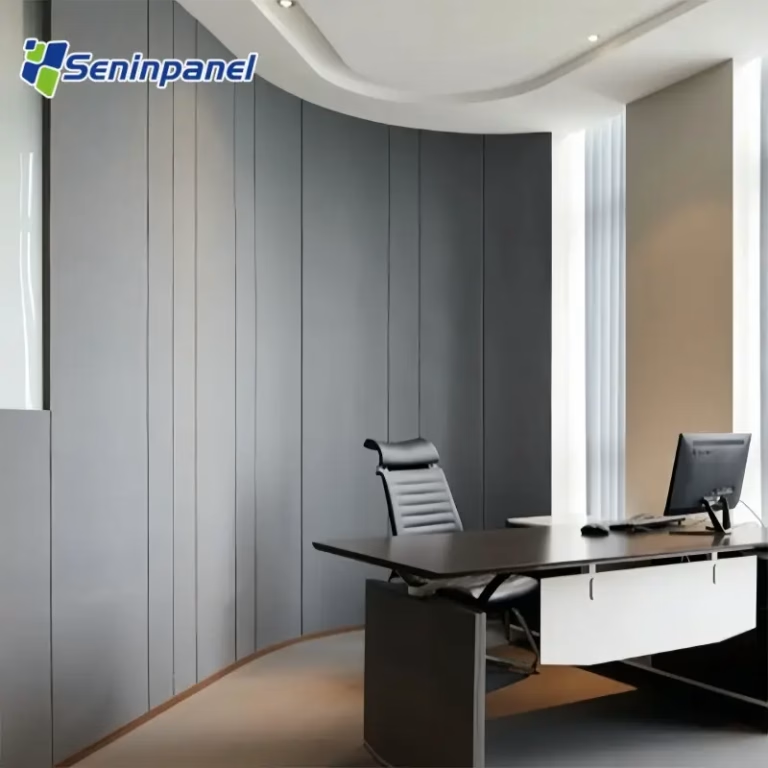
For Office Acoustic Panels, the priority is usually speech clarity and controlling excessive reverberation. Treatment may be distributed across walls and ceilings rather than concentrated in one location.
Home Theaters and Media Rooms
A home theater needs controlled reflections without removing too much acoustic energy. Side-wall reflection points, rear walls, and ceilings may require attention, while low-frequency problems often need a different treatment strategy.
Recording and Podcast Rooms
Recording spaces tend to require more deliberate control because microphones capture reflections that people may barely notice during normal conversation.
Restaurants and Public Spaces
In restaurants, cafés, reception areas, and similar spaces, the goal is often to reduce the overall buildup of reflected sound while maintaining a natural atmosphere.
The same Polyester Fiber Acoustic Panels can therefore be used differently depending on the room’s function.
4. Panel Performance Matters More Than Panel Count
Ten panels are not automatically equivalent to another ten panels.
Material thickness, density, mounting configuration, air gaps, and frequency all affect absorption performance. This is where technical information such as NRC and frequency-dependent absorption data becomes useful.
Seninpanel PET acoustic products, for example, are based on porous polyester fiber structures designed primarily to manage reflected sound. When comparing PET Acoustic Panels, it is more meaningful to examine tested acoustic performance and construction than to compare quantity alone.
Thicker treatment or an air cavity behind the panel can sometimes improve absorption at lower frequencies, but no single configuration performs equally across the entire audible spectrum.
For this reason, a smaller quantity of appropriately specified material can sometimes be more effective than covering a larger area with unsuitable panels.
5. Decide Between Wall and Ceiling Treatment
A common question is whether all acoustic treatment should go on the walls.
Not necessarily.
If a room contains extensive glazing, shelving, screens, artwork, or wood wall paneling, usable wall area may be limited. The ceiling can then become valuable acoustic real estate.
Acoustic Ceiling Panels, suspended baffles, and clouds can introduce absorption without occupying functional wall space. This is particularly useful in open offices, restaurants, schools, and commercial interiors.
A balanced combination of Acoustic Wall Panels and ceiling treatment can also distribute absorption more evenly around a room.
6. Placement Can Reduce the Number of Panels You Need
More panels do not automatically mean better acoustics.
Strategic positioning can often make a smaller treatment area more useful.
Consider large parallel walls, first-reflection areas, surfaces opposite major sound sources, and untreated ceilings. Instead of covering one entire wall for convenience, spreading panels across several important reflection areas may provide more balanced control.
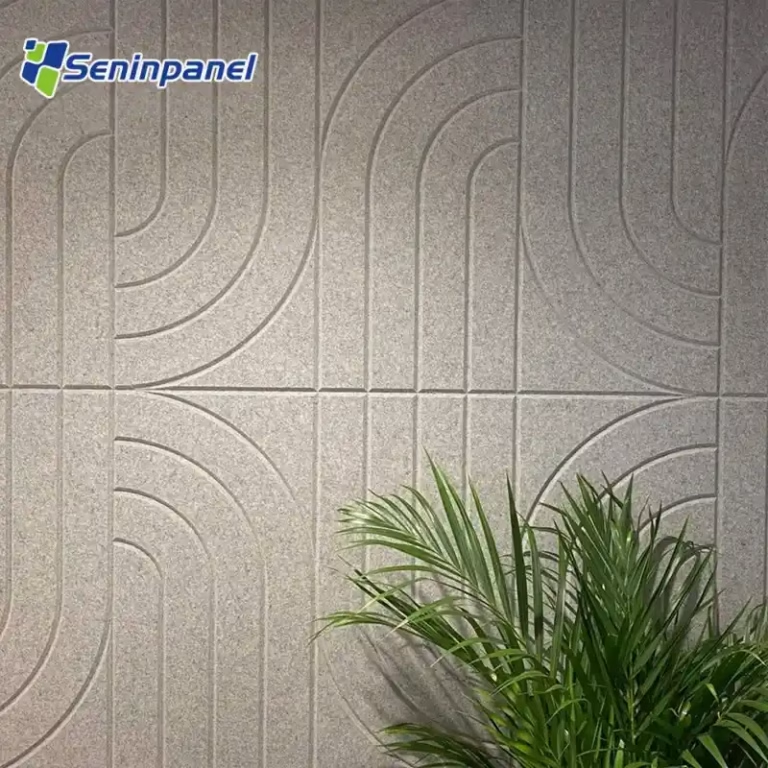
This is also where Decorative Acoustic Panels become useful. Geometric PET panels, slatted systems, suspended elements, and custom-cut shapes can place acoustic treatment where it is needed while becoming part of the interior design.
Seninpanel approaches these applications by considering acoustic function and visual layout together rather than treating the panels as an addition after the room has already been designed.
A Simple Way to Estimate Acoustic Panel Quantity
For an early-stage project, a practical workflow is:
Step 1: Measure the room’s length, width, and height.
Step 2: Identify major reflective surfaces such as glass, concrete, plasterboard, and tile.
Step 3: Consider existing absorptive materials such as carpet, curtains, and upholstered furniture.
Step 4: Define the room’s purpose and desired acoustic character.
Step 5: Select a preliminary treatment area rather than immediately choosing a panel count.
Step 6: Divide the required treatment area by the usable area of each panel.
For example, if an initial layout calls for 12 m² of treatment and each panel covers 0.72 m²:
12 ÷ 0.72 ≈ 16.7
The preliminary estimate would therefore be around 17 panels.
This remains a planning estimate—not a substitute for reverberation-time calculations or professional acoustic modeling when performance targets are specified.
Frequently Asked Questions
How many acoustic panels do I need for a room?
There is no fixed number. Room dimensions, ceiling height, reflective materials, furniture, panel performance, and intended use all affect the quantity. For preliminary planning, treatment area is usually more useful than panel count alone.
What percentage of a wall should be covered with acoustic panels?
Explore quantities from the actual room brief and relevant acoustic evidence. An arbitrary wall or ceiling percentage should not replace a suitable calculation or assessment of the listening conditions.
Are PET Acoustic Panels suitable for offices?
Yes. PET Acoustic Panels for offices can help reduce reflected sound and excessive reverberation in meeting rooms, open offices, reception areas, and collaborative spaces.
Can acoustic panels soundproof a room?
Acoustic absorption and soundproofing are different. Polyester Acoustic Panels primarily manage sound within a room. Reducing sound transmission between rooms usually requires changes to the wall, floor, ceiling, doors, or other parts of the building envelope.
Should acoustic panels go on the walls or ceiling?
They can be installed on either or both. The best location depends on reflection patterns, available surfaces, interior design, and room function.
Can I install too many acoustic panels?
Yes. Excessive absorption can make a space sound unnaturally dry while failing to solve specific low-frequency problems. The objective should be balanced acoustic control rather than maximum coverage.
Final Thoughts
Calculating how many acoustic panels you need is less about finding a universal formula and more about understanding how your particular room behaves.
Size matters, but so do ceiling height, surface materials, furniture, panel performance, placement, and room function.
For projects using Seninpanel PET Acoustic Panels or other Polyester Fiber Acoustic Panels, a sensible process is to start with the acoustic problem, estimate the treatment area, and then determine the panel quantity and layout.
In other words, don’t begin with “How many panels can fit on this wall?”
A more useful question is: How much absorption does this room actually need, and where will it make the greatest difference?