

Does PET Panel Density Affect Sound Absorption?
Category
Wood acoustic panels
Discover how PET acoustic panel density impacts sound absorption—optimal performance isn’t about more, but the right balance.
In modern interior design—whether for offices, co-working spaces, schools, or hospitality venues—acoustic comfort is no longer optional. At Seninpanel, we engineer high-performance PET acoustic panels that blend sustainability, aesthetics, and science-backed sound control. But one question often arises among specifiers and designers:
“Does increasing the density of PET panels always improve sound absorption?”
The answer isn’t linear—and understanding the relationship between density and acoustic performance can save time, cost, and installation headaches. Let’s break it down.

Table of Contents
1. What Are PET Acoustic Panels? Performance at a Glance
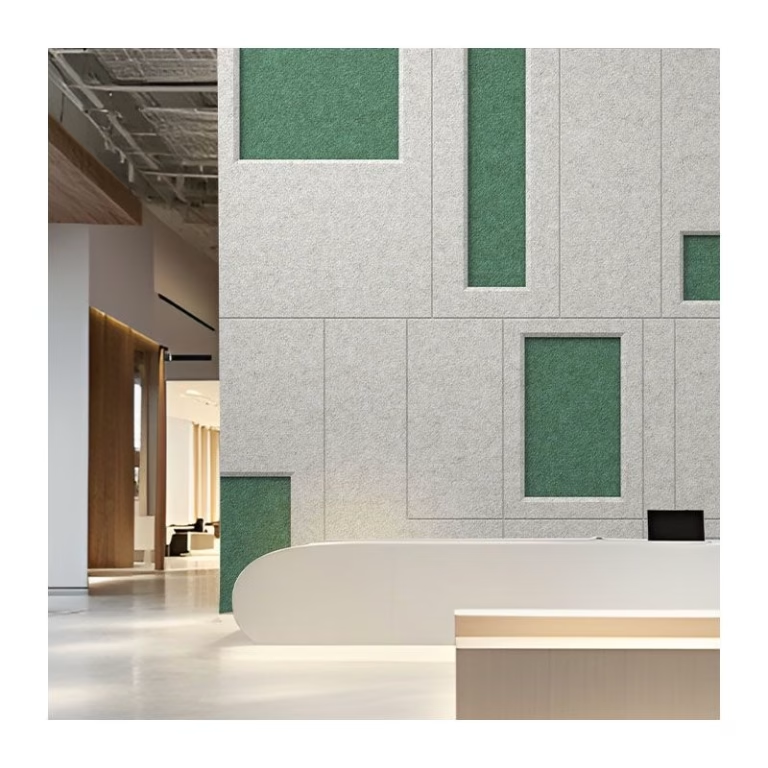
Made from recycled polyester fiber (PET), our acoustic panels are eco-friendly, non-toxic, and highly effective at managing reverberation.
Typical sound absorption coefficients (α) for quality PET acoustic panels range from 0.6 to 1.0 across the 100–5000 Hz frequency spectrum—depending on thickness, surface treatment, and yes, density.
For example, under EN ISO 354:2003 (Type E mounting, simulating real-world wall/ceiling installations), a standard Seninpanel product achieves:
- Average α = 0.7 (100–5000 Hz)
- NRC (Noise Reduction Coefficient) = 0.8
- Acoustic Classification: Class B per EN ISO 11654:1997
This makes them ideal for speech clarity in meeting rooms and noise reduction in open-plan offices.
2. The Density Dilemma: More Isn’t Always Better
Density—measured in grams per square meter (gsm)—directly influences airflow resistance, a key factor in how sound energy is converted into heat within the panel.
🔹 Low Density (<1350 gsm)
- Too porous → sound waves pass through without sufficient interaction.
- Poor absorption, especially in mid-frequencies (500–2000 Hz) critical for speech intelligibility.
🔹 Optimal Range (1350–2200 gsm)
- Balanced airflow resistance → maximum energy dissipation.
- Consistent NRC values (±5% variation).
- Ideal for most commercial applications—offering structural integrity without unnecessary weight.
🔹 High Density (>2200 gsm)
- Over-compaction reduces pore connectivity.
- Diminishing returns: absorption plateaus or even dips slightly in high frequencies.
- Higher material cost and shipping weight—with minimal acoustic benefit.
💡 Practical Insight: Once you’re within the 1350–2200 gsm sweet spot, further increasing density rarely justifies added cost or logistical burden.
3. How Do We Measure Performance? Trust the Standards
At Seninpanel, every product batch undergoes rigorous third-party acoustic testing. Key standards include:
- EN ISO 354:2003: Measures sound absorption in a reverberation chamber (realistic room simulation).
- EN ISO 11654:1997: Calculates NRC by averaging α at 250 Hz, 500 Hz, 1 kHz, and 2 kHz—the core frequencies for human speech.
⚠️ Always ask for certified test reports. Not all “acoustic” panels deliver real performance—some rely on visual appeal alone.
4. Real-World Design Tips: Beyond Density
While density matters, it’s not the only lever:
- Thickness: Thicker panels (e.g., 25mm vs. 12mm) absorb lower frequencies more effectively.
- Surface Perforation: More or larger pinholes enhance high-frequency absorption.
- Mounting Method: Air gaps behind panels boost low-end performance (Type A/E mounting).
For architects & interior designers: Prioritize panel layout, coverage area, and integration with other soft surfaces (curtains, carpets).
For contractors & installers: Within the optimal density range, focus on fire ratings (B1/B-s1,d0), ease of cutting, and aesthetic finish.
5. Why Choose Seninpanel?
As a source manufacturer, we control every step—from recycled PET sourcing to precision cutting and finishing. Our panels are:
- 100% recyclable & formaldehyde-free
- Available in custom shapes, colors, and textures
- Backed by full acoustic test reports
- Designed for commercial durability + design-forward spaces
Ready to Optimize Your Space?
If you’re evaluating acoustic solutions for an upcoming project—or want to compare NRC curves across densities—we’ve published a detailed technical report with real-world test data across 12+ PET panel variants.
Where Can You Use wood acoustic panels?
Bedrooms
Turn your bedroom into a serene sanctuary using acoustic SlatWall panels.These panels have a backing made of recycled felt that helps absorb sound, creating a quieter environment perfect for relaxing. If you want a modern headboard look, go for half-height panels. For a full display of the wood’s natural textures and grain patterns, choose the full-height option.
Living Rooms and Cinema Rooms
Add warmth and elegance to your home with the classic charm of SlatWall panels. The natural wood finish promotes relaxation by introducing texture and depth, offering a welcoming and modern appearance. These panels are perfect for modern media walls and can also enhance sound quality.
Hallways and Stairs
Create a strong first impression with SlatWall panels in your hallways and staircases. The slatted design offers texture and personality to these areas while keeping a sleek, contemporary look. Choose half-height panels for a fresh take on traditional wainscoting. Go for Premium Oiled finishes to boost durability and resist stains, perfect for high-traffic zones.
Ceilings
Enhance the fifth wall of your room by extending SlatWall panels to the ceiling, creating a dramatic design feature. The slatted pattern adds depth, gives the impression of a longer space, and enhances sound quality, fostering a more open and tranquil atmosphere in any room.