
How Hexagon Acoustic Panels Work: Material, Shape and Mounting
Hexagon acoustic panels combine a geometric layout with a specified acoustic material. Their absorption depends on the finished construction and mounting; a hexagonal outline alone does not establish diffusion, sound isolation or a product rating.
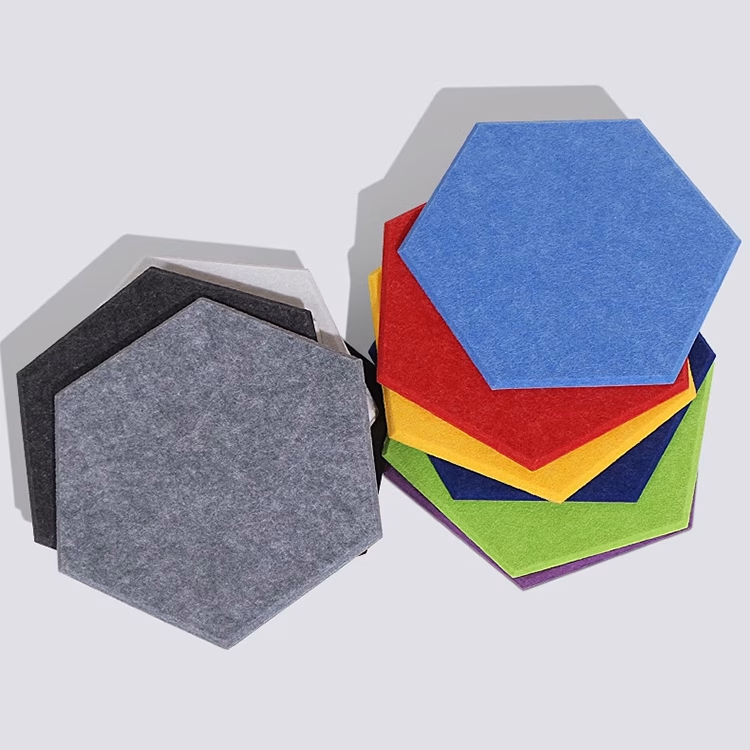
Table of Contents
Hexagon describes the outline, not the acoustic rating
A hexagonal tile can be cut from a flat PET felt sheet. Its visible outline creates a repeatable pattern, but the word hexagon does not describe the material inside it. Do not assume a honeycomb core, internal damping fill or special sound-scattering construction unless the selected product’s drawing and specification identify one.
For PET felt, the relevant discussion is normally porous sound absorption: sound interacting with the fibrous construction can lose energy rather than all reflecting back into the room. The degree and frequency dependence need evidence for the actual product. Shape alone cannot tell you the result.
Compare the variables that belong with a test result
| Feature | Useful information | Unsupported shortcut |
|---|---|---|
| Hexagonal outline | Module layout, joints and visual pattern | Assuming the shape guarantees diffusion |
| PET material and thickness | Identity of the specified board | Assigning a universal NRC from the material name |
| Backing, cavity and fixings | Complete installation section | Using a cavity-backed result for every direct-fixed tile |
| Quantity and placement | Where treatment occurs in the room | Equating geometric wall coverage with percentage noise reduction |
Absorption, diffusion and isolation answer different questions
Absorption concerns reflected sound energy. Diffusion concerns the distribution of reflected sound. Isolation concerns sound transmission between spaces. A decorative outline is not proof of an engineered diffuser, and closely fitted felt tiles do not turn a wall into a sound-isolating barrier.
If the problem is traffic through a window or speech through a door, investigate that path separately. Use the absorption and soundproofing FAQ to distinguish the next questions. Do not promise control of machinery, impact noise or speech privacy from a surface tile label.
Read the report before comparing products
Request the panel reference, thickness, specimen dimensions, mounting and frequency-band results. An average absorption rating does not describe every frequency and is not a percentage reduction in the sound level of a completed room. Compare like constructions and retain the report with the selected specification.
ISO 354 describes sound-absorption measurement in a reverberation room. A method reference explains the measurement approach; it does not establish a Seninpanel product certification or guarantee the result of a particular tile pattern.
Move from the material to the room layout
Define the room use, dimensions, listening positions and available surfaces. Coordinate openings, sockets, furniture and the permitted fixing method. Ceiling installations require explicit overhead suitability and support; do not assume that a wall tile or its adhesive can be used overhead.
Use the hexagon pattern and quantity guide for a scaled layout, and the hexagon applications guide for room-specific checks. Review the hexagon wall panel product page for a supplier discussion. Confirm the actual material, model, dimensions and supporting documents before ordering.